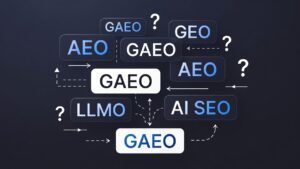
GAEO: What It Is and Why It’s Different From SEO
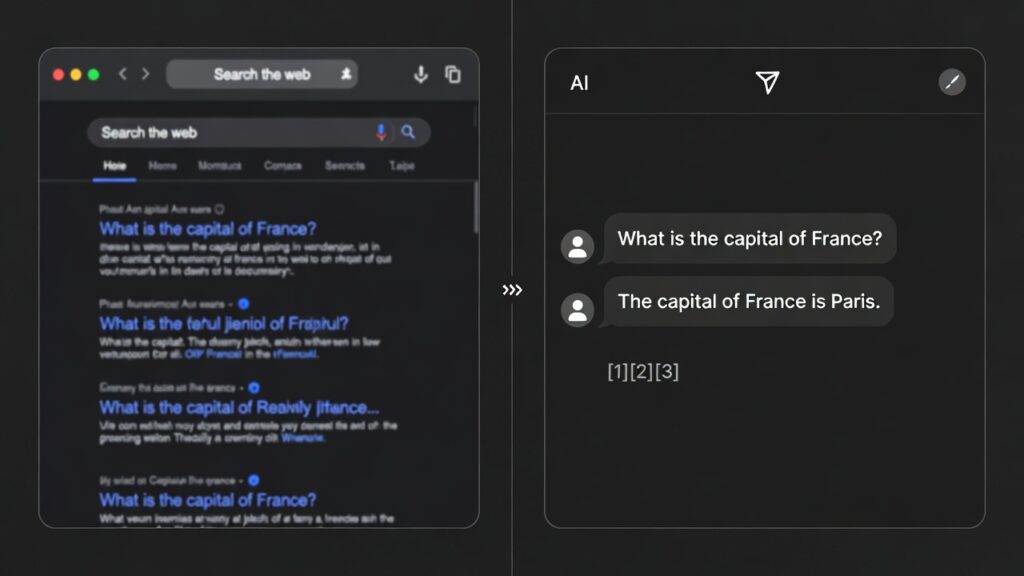
GAEO stands for Generative AI Engine Optimization. It’s the practice of making your content visible to AI systems (ChatGPT, Claude, Perplexity, Gemini) so they can find, understand, and cite it.
SEO optimizes for Google’s ranked list of links. GAEO optimizes for AI-generated answers.
What GAEO Actually Involves
Four things:
1. AI crawler access. AI systems send bots to crawl the web (GPTBot, ClaudeBot, PerplexityBot). You control access via robots.txt. Block them and you’re invisible. Full crawler list.
Worth knowing: 80% of AI crawling is for training data, 18% for search indexing, and just 2% for user-triggered actions. Most crawlers aren’t sending you traffic. They’re collecting training data.
2. Site-level context. llms.txt tells AI what your site is about. Schema markup (Organization, Article, FAQ) adds structured data AI can parse. Both help AI categorize and cite you correctly.
3. Content structure. AI extracts information differently than humans read. Clear headings, FAQ sections, direct answers, and logical organization make your content easier to cite.
4. Authority signals. Original research, expert authors, external citations, topical depth. Same factors that help SEO, applied to AI.
How It’s Different From SEO
| SEO | GAEO | |
|---|---|---|
| Goal | Rank in search results | Get cited in AI answers |
| You win when | Users click your link | Your info appears in the response |
| Key signals | Backlinks, keywords | Clarity, structure, authority |
| Control | Extensive (meta tags, sitemaps, Schema) | Limited (robots.txt, llms.txt) |
The hard truth: in SEO, success always means traffic to your site. In GAEO, you might “win” when AI uses your information without anyone clicking through. Perplexity sends traffic because it cites sources. ChatGPT often doesn’t.
What GAEO Won’t Do
It won’t make bad content good. If your content is thin or inaccurate, no amount of optimization helps. AI systems are decent at recognizing quality.
It won’t guarantee citations. You can do everything right and still not get cited for a query. AI responses are probabilistic. Your odds improve, but outcomes aren’t deterministic.
It won’t replace SEO. Google still drives most search traffic. GAEO is an additional channel, not a replacement.
Should You Care?
Yes, if you publish content that answers questions and want to stay visible as AI search grows.
No, if your site is purely transactional or you’re intentionally blocking AI crawlers.
For most publishers, GAEO effort is modest. The tactics overlap with good SEO and UX, and the upside grows as AI adoption increases.
Getting Started
- Make sure AI crawlers can access your site (check your robots.txt)
- Create an llms.txt file
- Verify your schema markup is present and accurate
- Review high-value content for clear structure and direct answers
- Track referrals from AI sources in your analytics
FAQ
Is GAEO replacing SEO?
No. Google still dominates search traffic. GAEO is complementary.
What’s the difference between GAEO and GEO?
Same thing. GEO (Generative Engine Optimization) is just shorter. Some academic papers use GEO; marketing people often say GAEO. More on terminology.
Do I need special tools for GAEO?
Not necessarily. You can manage robots.txt and create llms.txt manually. Plugins like GetCited make it easier but aren’t required.
How do I know if GAEO is working?
Track referral traffic from AI sources (perplexity.ai, chatgpt.com) in Google Analytics. Manually search queries your content should answer and check for citations.
Malcolm Michaels is the founder of HeyTC and creator of GetCited. This post was developed with AI assistance: human direction, AI drafting, human editing.